
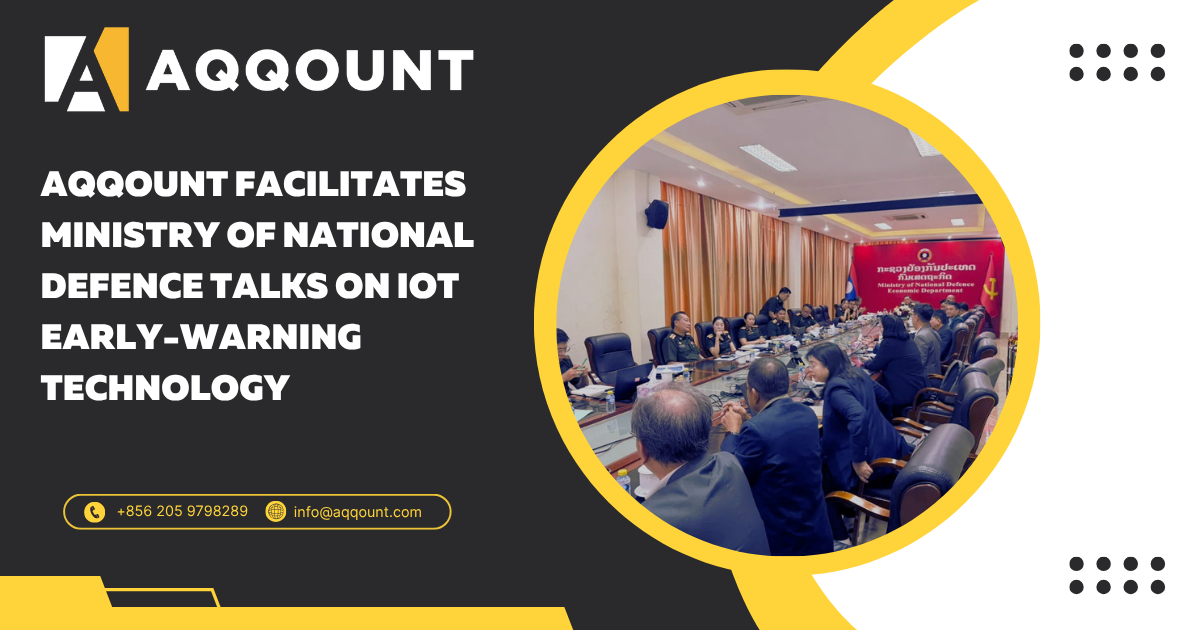
Vientiane Capital, 26/08/2026 — AQQOUNT Investment and Consulting Sole Co., Ltd. facilitated an official introductory meeting between an international investor, a technology partner, and the Economic Department of Laos’ Ministry of National Defence, focused on deploying IoT-based natural disaster alert systems — with long-term potential to extend into carbon credit generation.
The meeting, held at the Ministry’s headquarters in Vientiane, brought together senior officials from the Economic Department with representatives of the investor and technology delegation to discuss how remote sensor networks could support early detection of floods, wildfires, and other natural hazards affecting land and infrastructure under the Ministry’s purview.

Why Disaster Alert Technology Matters for Laos
Laos faces recurring exposure to flooding, wildfire, and extreme weather — risks that affect not only agriculture and rural livelihoods but also strategic infrastructure and land assets. Real-time environmental monitoring closes a critical gap: it gives institutions the ability to detect and respond to hazards before they escalate into major losses, rather than assessing the damage after the fact.
For a ministry responsible for extensive land holdings and infrastructure nationwide, early-warning capability is a direct, practical way to protect assets, personnel, and surrounding communities.
From Early-Warning Concept to Carbon Opportunity
This was an initial, exploratory meeting — no agreement or commitment to proceed has been made by either side. What emerged was a shared interest in a possible long-term direction: IoT-based monitoring could, in principle, give the Ministry real-time visibility into flood- and disaster-prone areas, and that same kind of continuous, verifiable environmental data is also the foundation carbon credit methodologies require. Whether and how that translates into an actual project remains to be determined in future discussions.
This possible direction mirrors the tripartite model AQQOUNT has been advancing in Laos more broadly: pairing local institutions, international technology partners, and structured green finance advisory to convert climate risk into measurable, bankable value.
AQQOUNT’s Role
AQQOUNT’s role in this meeting was as facilitator and advisor — bringing an international investor and technology partner to the table with a Lao government counterpart, and helping frame the discussion around a realistic, phased path from disaster alert to potential carbon finance. This is consistent with AQQOUNT’s Green Finance & Sustainability practice, which supports environmental IoT monitoring and carbon credit advisory for institutions and businesses operating in Laos.
The meeting concluded with an exchange of courtesies between the delegations, and both sides indicated interest in continuing the dialogue as next steps are scoped.
Looking Ahead
This engagement adds to a growing list of government- and institution-level conversations AQQOUNT has supported in 2026 around green finance, disaster resilience, and climate-linked investment in Laos. Investors, technology providers, and public institutions interested in IoT-based environmental monitoring or carbon credit structuring in Laos are welcome to connect with AQQOUNT to explore collaboration.
Frequently Asked Questions
What was discussed at the meeting? Deployment of IoT-based natural disaster alert systems (flood, wildfire, and related environmental monitoring) for land and infrastructure under the Ministry of National Defence’s Economic Department, and the long-term potential to link that monitoring data to carbon credit opportunities.
Is this a signed agreement? No. This was an official introductory meeting between the investor, technology partner, and the Ministry’s Economic Department to explore collaboration — not a finalized deal.
How does disaster alert technology connect to carbon credits? Verified, continuous environmental data from IoT sensors is the kind of evidence carbon credit methodologies require. A disaster-alert deployment can, over time, be structured to also support carbon credit eligibility assessments.
What was AQQOUNT’s role? AQQOUNT facilitated the introduction between the international investor, technology partner, and the Ministry, and advised on framing the collaboration.